Works in horizontal property developments (propiedad horizontal tumbada) | STS 432/2026
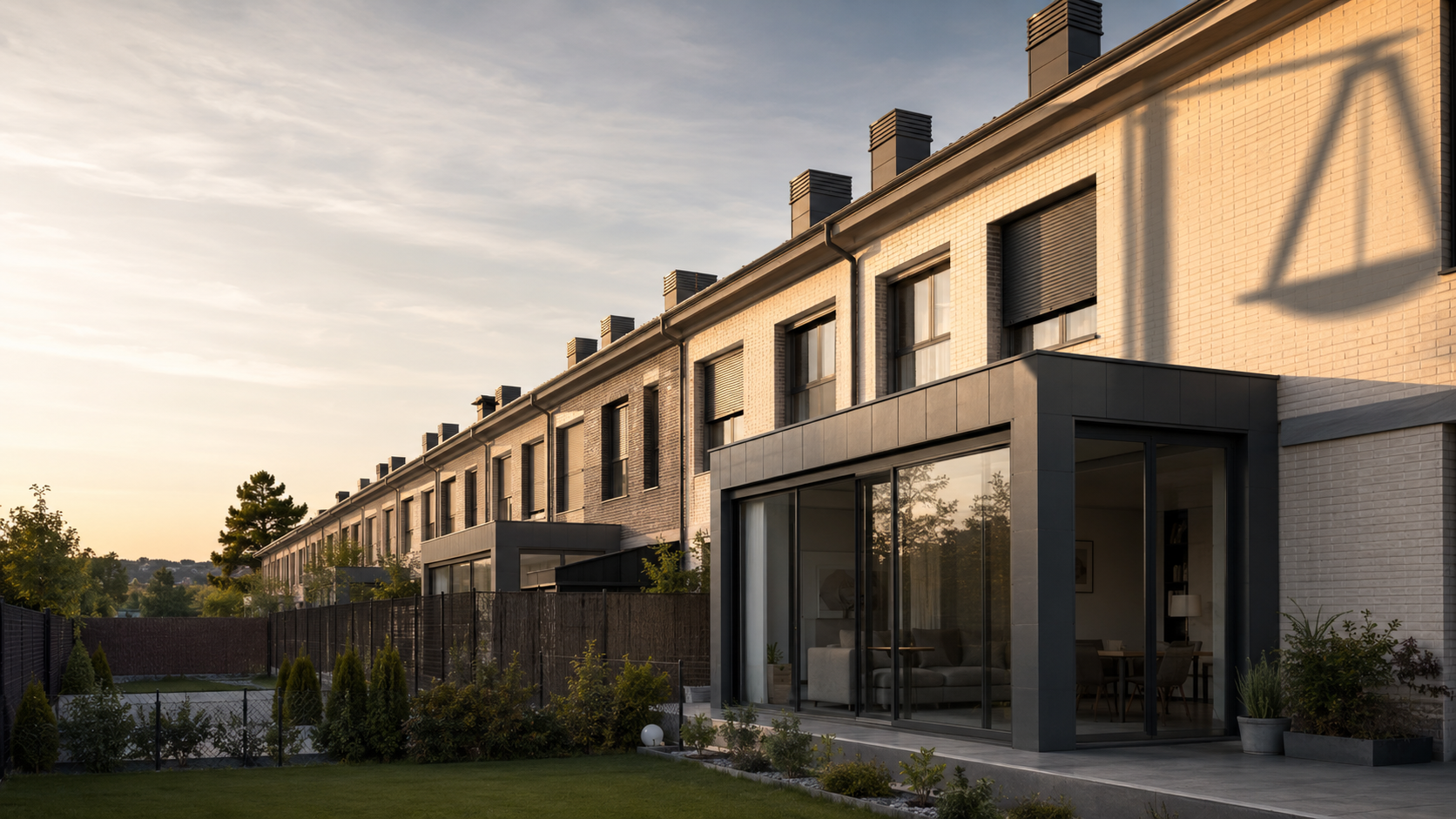
The so-called "horizontal property development" (propiedad horizontal tumbada) does not grant owners absolute freedom to extend or modify their homes. Even if the constitutive title attributes a private nature to facades, roofs, or structures, any works must respect the bylaws, the configuration of the real estate complex, and the rights of other owners.
This was declared by the First Chamber of the Supreme Court in its Judgment 432/2026, of March 18, issued in appeal 3262/2021, with Magistrate José Luis Seoane Spiegelberg serving as rapporteur. The ruling confirms the demolition of an extension carried out in the garden of a terraced house because it exceeded the works authorized by the bylaws, altered the uniform appearance of the complex, and prejudiced the light and views of the adjacent property.
Resolution Data
Court: Supreme Court, First Civil Chamber.
Judgment: 432/2026, of March 18.
Appeal: 3262/2021.
Rapporteur: José Luis Seoane Spiegelberg.
ECLI: ES:TS:2026:1389.
ROJ: STS 1389/2026.
Origin: Provincial Court of Navarra, Third Section.
The conflict: an extension built on a private garden
The litigation involved the owners of two adjacent houses integrated into a complex of ten terraced single-family homes located in Murchante, Navarra.
The complex had been formally constituted under a horizontal property regime. The houses shared a uniform construction configuration and certain access and circulation spaces in the basement.
The constitutive title classified the roofs of the basement access ramp and the maneuvering and circulation areas as common elements. At the same time, it declared that the facades, foundations, structures, and roofs of the ten houses were not common elements, given the unique nature of the "horizontal property development."
The bylaws allowed each owner to freely carry out works inside their home. Regarding the facades, they authorized certain actions—such as ornamentation works, the placement of awnings, or the opening and closing of gaps—provided they did not jeopardize the safety of the building or affect common elements. For matters not provided for, they expressly referred to the Horizontal Property Act (Ley de Propiedad Horizontal).
The defendant owners notified the community of their intention to extend the house. Although the community asked them to provide the project to examine its legality, they executed the works with a municipal license.
The action consisted of extending the ground floor over the back garden to the depth permitted by urban planning. The extension allowed for the enlargement of the living room and the construction of a new bedroom and a toilet. To do this, an opening was made in the facade and a new volume was erected with lateral enclosures, a facade, and a roof.
The adjacent neighbors sought judicial relief for the demolition and the restoration of the house to its previous state.
The different court responses
The Court of First Instance No. 3 of Tudela initially dismissed the claim. It understood that, according to the constitutive title, the facades, enclosures, and roofs were not common elements and, therefore, the work did not require authorization from the homeowners' association meeting.
The Provincial Court of Navarra overturned this decision. It considered that the facade, roof, foundation, ground, and airspace had a common nature that could not be ignored due to its physical configuration. Consequently, it ordered the owners to demolish the extension and restore the property to its previous state.
The sentenced parties filed an extraordinary appeal for procedural infringement and a cassation appeal. They argued, in essence, that the Provincial Court had ignored the autonomy of will recognized in Article 1255 of the Civil Code and the content of the constitutive title.
The Supreme Court dismissed the cassation appeal and confirmed the demolition. The extraordinary appeal for procedural infringement remained unexamined as it lacked practical utility once the substantive challenge was dismissed.
What is a horizontal property development (propiedad horizontal tumbada)?
The judgment relies on the doctrine of STS 215/2015, of April 29, to explain that in these complexes, two spheres of ownership coexist:
Exclusive ownership corresponding to each house or plot.
The community of interests derived from the integration of all of them into an organized urbanization or complex.
This community of interests is not limited to the material maintenance of common elements. It also includes the purpose and use of the properties, the relationships between owners, coexistence, and the preservation of the general configuration of the complex.
Horizontal property development is not, therefore, equivalent to a grouping of completely independent properties. The autonomy of each owner is conditioned by their membership in a common real estate reality.
Article 24 of the Horizontal Property Act provides the legal framework for private real estate complexes. In the case analyzed, furthermore, the bylaws themselves contained an express reference to said law for all matters not specifically regulated.
The decisive question: the true scope of the bylaw authorization
The Supreme Court does not base its decision exclusively on determining whether the facade was common or private. The core of its reasoning consists of interpreting the scope of the bylaws.
These allowed for works to be carried out freely inside the houses but subjected interventions on the facades to specific regulation. The authorization included limited actions, such as ornamentation, the placement of awnings, or the opening and closing of gaps.
The litigated extension was qualitatively different. It was not limited to modifying a gap or introducing an ornamental element, but rather extended the house beyond its original enclosure, occupied part of the garden, and created a new construction intended to increase the living area.
The work, therefore, fell outside the provisions of the bylaws.
The Chamber adds that the ten houses shared a uniform architectural structure and offered the material appearance of a single facade. The extension altered that aesthetic configuration and, by erecting a side wall, reduced the light and views of the garden of the plaintiff owners.
Consequently, the work not only exceeded the bylaw authorization: it also caused specific damage to the rights of the neighbors.
The application of Article 7.1 of the Horizontal Property Act
The judgment recalls the limitation established in Article 7.1 of the Horizontal Property Act. This provision allows for the modification of architectural elements, installations, or services of each property provided that the action:
Does not undermine the safety of the building.
Does not alter its general structure.
Does not modify its configuration or exterior state.
Does not prejudice the rights of another owner.
Is previously communicated to the representative of the community.
Therefore, the private nature of the garden on which it is built is not enough to legitimize the work. Nor is it sufficient for the owner to have an urban planning license.
The municipal authorization proves that the action is admissible from an urban planning perspective, but it does not resolve the internal civil relationships between the members of the community. The work may comply with planning and, at the same time, violate the constitutive title, the bylaws, or the Horizontal Property Act.
The autonomy of will has limits
The appellants invoked Article 1255 of the Civil Code to defend the effectiveness of the constitutive title and the bylaws. However, this principle does not allow for a bylaw clause to be interpreted in an unlimited manner or in isolation from the rest of the legal system.
The bylaws define the rights and obligations of the owners, but they must be interpreted:
According to their wording and purpose.
In relation to the set of their clauses.
In accordance with the mandatory rules of the Horizontal Property Act.
Respecting the legitimate rights of the other members of the community.
In this case, the bylaw autonomy did not support any extension. The clause authorized certain interventions on the facades, not the construction of new rooms outside the original perimeter of the house.
Furthermore, the first transitional provision of Law 8/1999 establishes that the Horizontal Property Act is applicable to all communities, regardless of the time of their creation, and that the bylaws cannot be applied in contradiction to it.
Could other tolerated actions justify the work?
The owners also alluded to the existence of similar works in other houses.
This argument also failed. The Provincial Court had determined that the other actions were not comparable: some lacked a permanent nature and the one that did have it had been expressly authorized by the community.
The Supreme Court further points out that the process should be limited to assessing the legality of the specifically challenged work. The existence of other actions does not automatically make a work that is contrary to the bylaws and harmful to third parties lawful.
Prior tolerance will only be relevant when there is a true identity between the works and allows for the appreciation, according to the circumstances of the case, of tacit consent, discriminatory treatment, abuse of right, or violation of one's own acts (doctrine of estoppel). A generic reference to other modifications made in the complex is not enough.
The doctrine that can be extracted from the judgment
The resolution allows for the formulation of a conclusion of special practical interest:
In a horizontal property development, private ownership of the affected space does not authorize any construction work. The work must respect the bylaws, the architectural configuration of the complex, and the rights of the other owners.
Several rules derive from this conclusion:
The term "horizontal property development" does not eliminate the application of the Horizontal Property Act.
The constitutive title must be interpreted together with the bylaws and with the physical and functional reality of the property.
A generic authorization to execute works does not necessarily include structural extensions or new building volumes.
Facades and exterior appearance may be protected by community regulations even when the title does not formally classify them as common elements.
The urban planning license does not replace the civil or community consent that may be required.
Works executed on private elements may be illegal if they alter the exterior configuration or prejudice the light, views, or other rights of the neighbors.
The consequence can be demolition and the restoration of the property to its previous state.
Practical relevance for owners and communities
Before undertaking an extension in a house integrated into an urbanization or real estate complex, it is advisable to review at least four regulatory levels:
The constitutive title.
The community bylaws.
Applicable community agreements.
The Horizontal Property Act.
The material impact of the action on the facade, roof, structure, ground, airspace, architectural uniformity, and rights of adjacent properties must also be checked.
For communities, the judgment advises avoiding decisions based solely on the formal label of a "private" or "common" element. The evaluation must also consider the physical configuration of the complex, the full content of the bylaws, and the damage that the work may cause.
For their part, anyone planning an extension should obtain a clear definition of its civil feasibility before starting the work. Executing the work relying exclusively on a municipal license may end in a court order to demolish it, with the consequent economic costs.
Conclusion
STS 432/2026 reinforces a functional conception of horizontal property development. The existence of private homes and spaces does not erase the community of interests that arises from their integration into the same architectural complex.
Ownership freedom and bylaw autonomy remain relevant, but they find their limit in the configuration of the complex, in the rules of the Horizontal Property Act, and, especially, in the prohibition of harming the rights of other owners.
In short: building on a private element does not mean being able to build in any way. When an extension exceeds what is permitted by the bylaws, alters the exterior unity of the complex, and reduces the neighbor's light or views, the judicial response can go as far as demolition.
Reference: Supreme Court, First Chamber, Judgment 432/2026, of March 18, appeal 3262/2021, ECLI:ES:TS:2026:1389.
Sources consulted: text and file of the judgment and jurisprudential summary of the General Council of the Judiciary.
This article is for informational purposes and does not constitute legal advice.